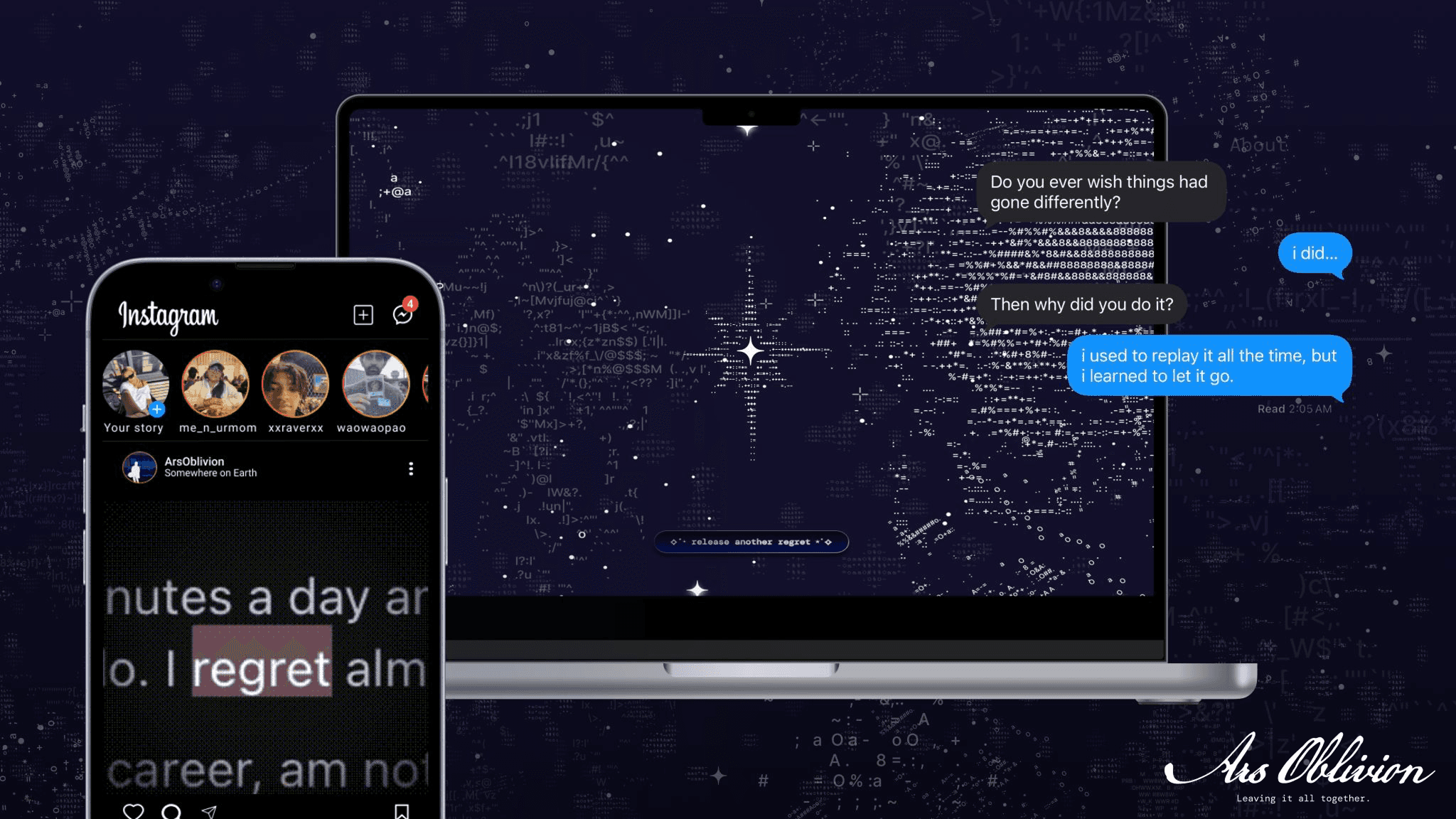

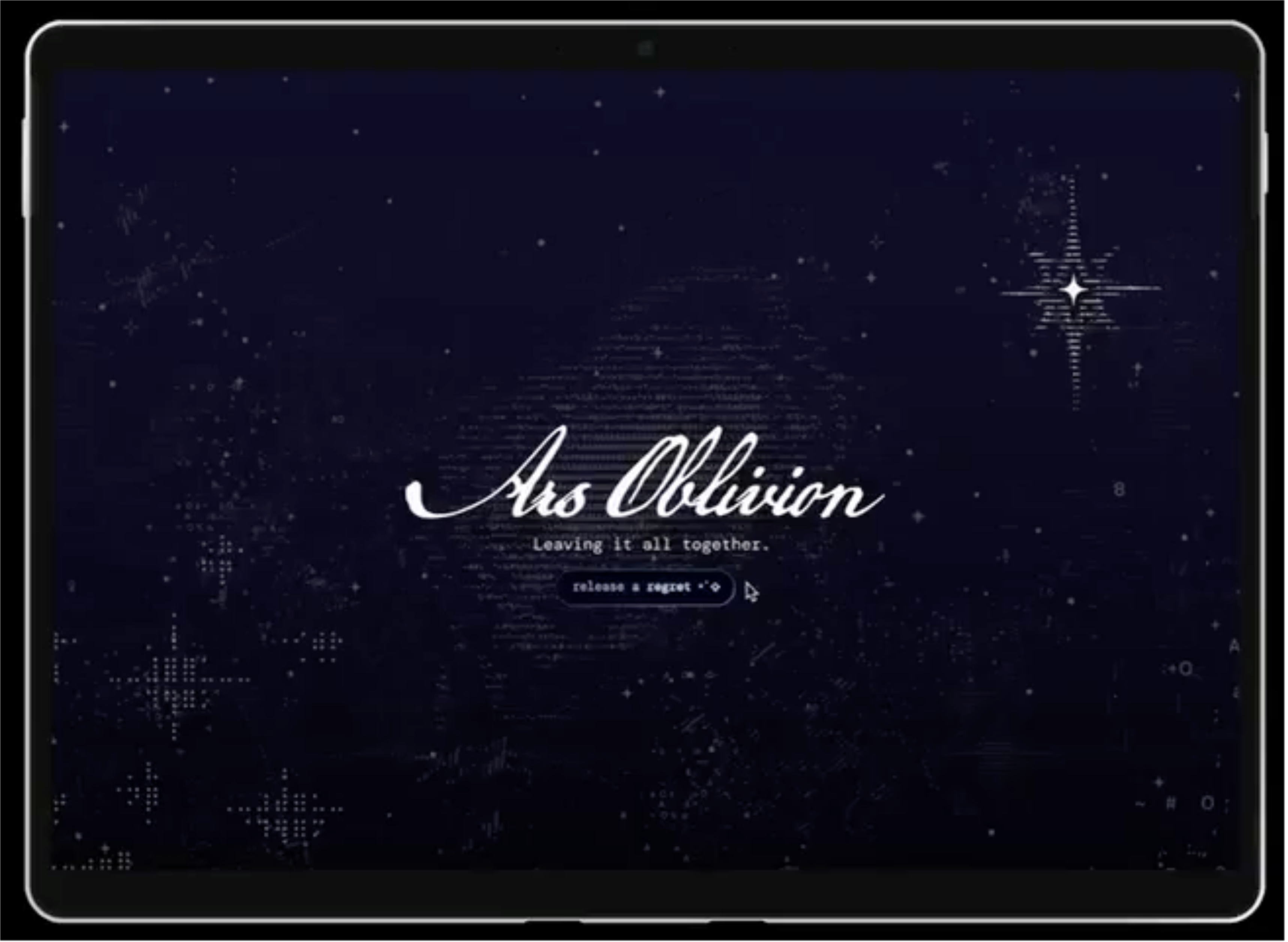
Ars Oblivion is a digital platform where young adults anonymously release their regrets into a collective void.
ARS
OBLIVION
UCI 2026 Desing-A-Thon: Top 5 Professional Track
5 minute read
SKILL & GROWTH
Unique Concept To Life: The Art of Letting Go
Ars Oblivion isn't magic. Releasing a regret into the void won't make you forget, and it was never meant to. The intention is quieter than that: to remind you that you are not alone in what you carry. Every regret you release joins countless others, held by people just like you, living their lives on the same earth. It's an invisible contract between you and the universe — a quiet declaration that you are ready to let go. No data saved. No one watching. No interference. Just you, and the choice to release.
This project was challenging, but rewarding in the end. Tackling the idea of forgetting while weaving in a sense of community wasn't easy — regrets are deeply personal, and finding a way to honor that intimacy while still making something that felt collective and uniquely its own was one of the most meaningful design problems we've ever solved.
User Interviews
USER RESEARCH
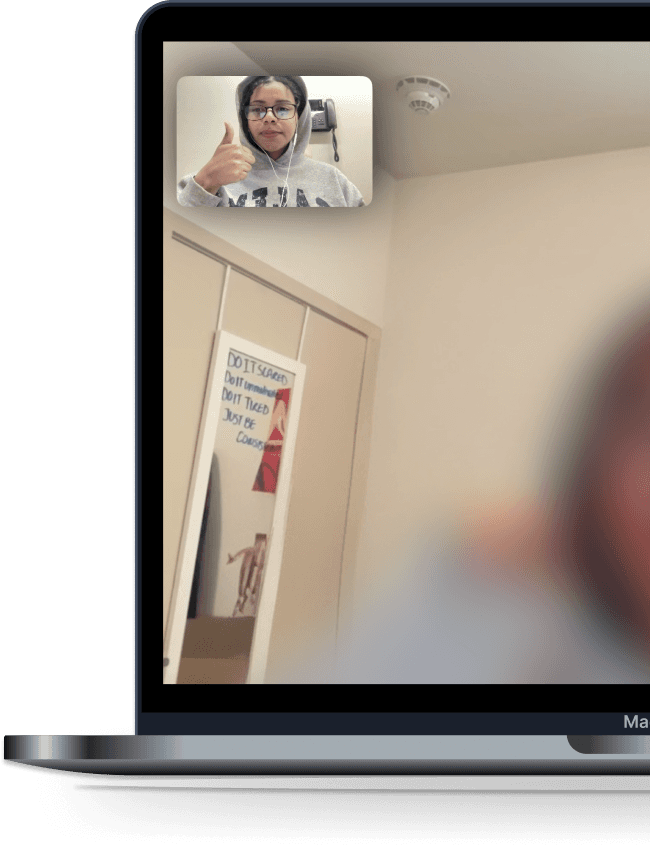
We conducted qualitative interviews with 7 college students, ages 19–22, to understand how young adults experience and process regret.
2
1
3
Regret is tied to identity
Users linked regret to moments of immaturity, disappointing others, or wishing they had acted differently.
No Performance
The space is private and honest, not built for validation or display.
Emotional Release
The platform transforms regret into a moment of closure, allowing users to move forward with less emotional weight.
We archive our mistakes because they left a mark, while our joys fade because they don't linger. Just like machine learning, we need the failure to map out the flight. You have to stumble once to know exactly where you'll never walk again”
Maliyah Miller, 19
“
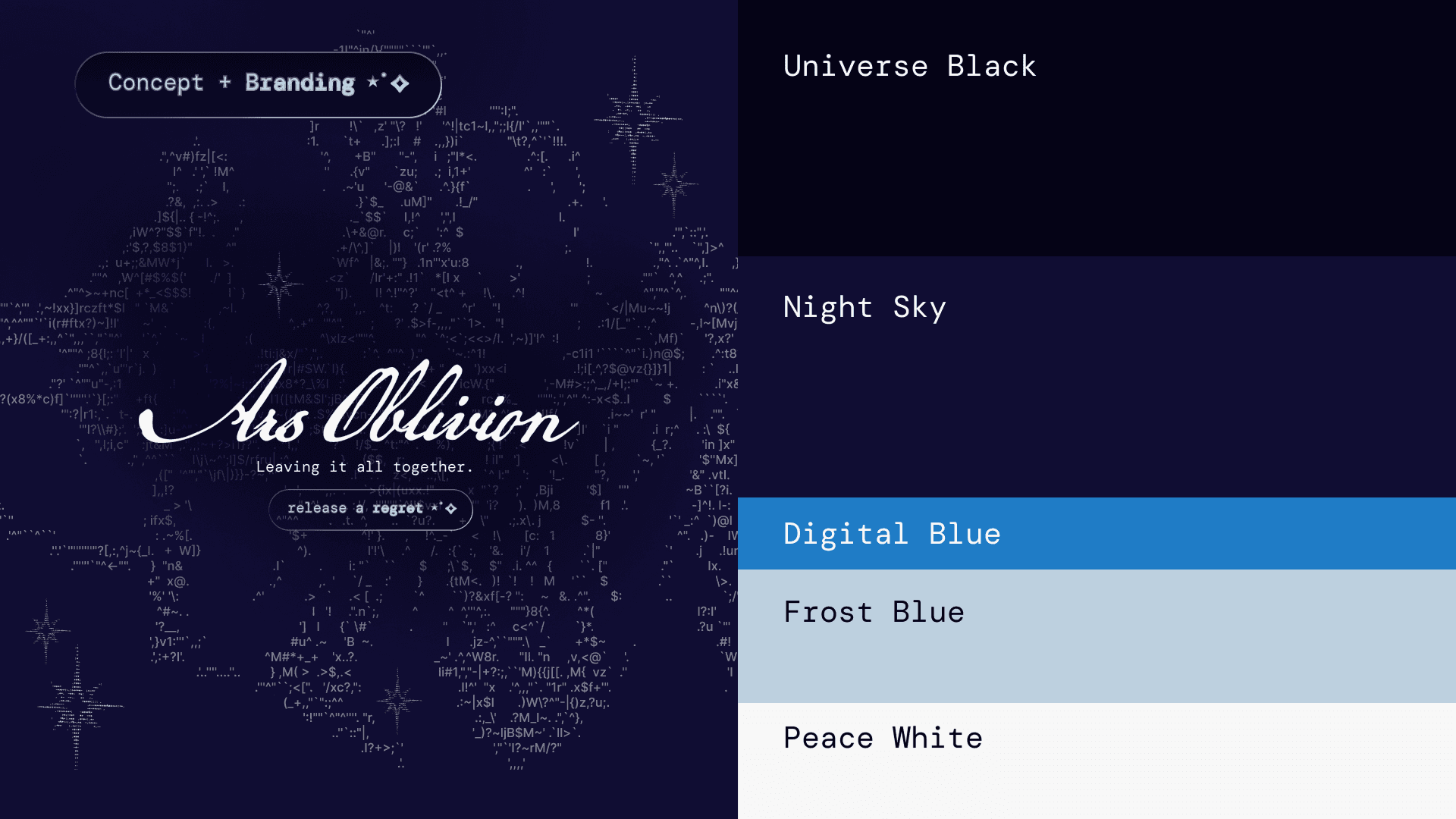
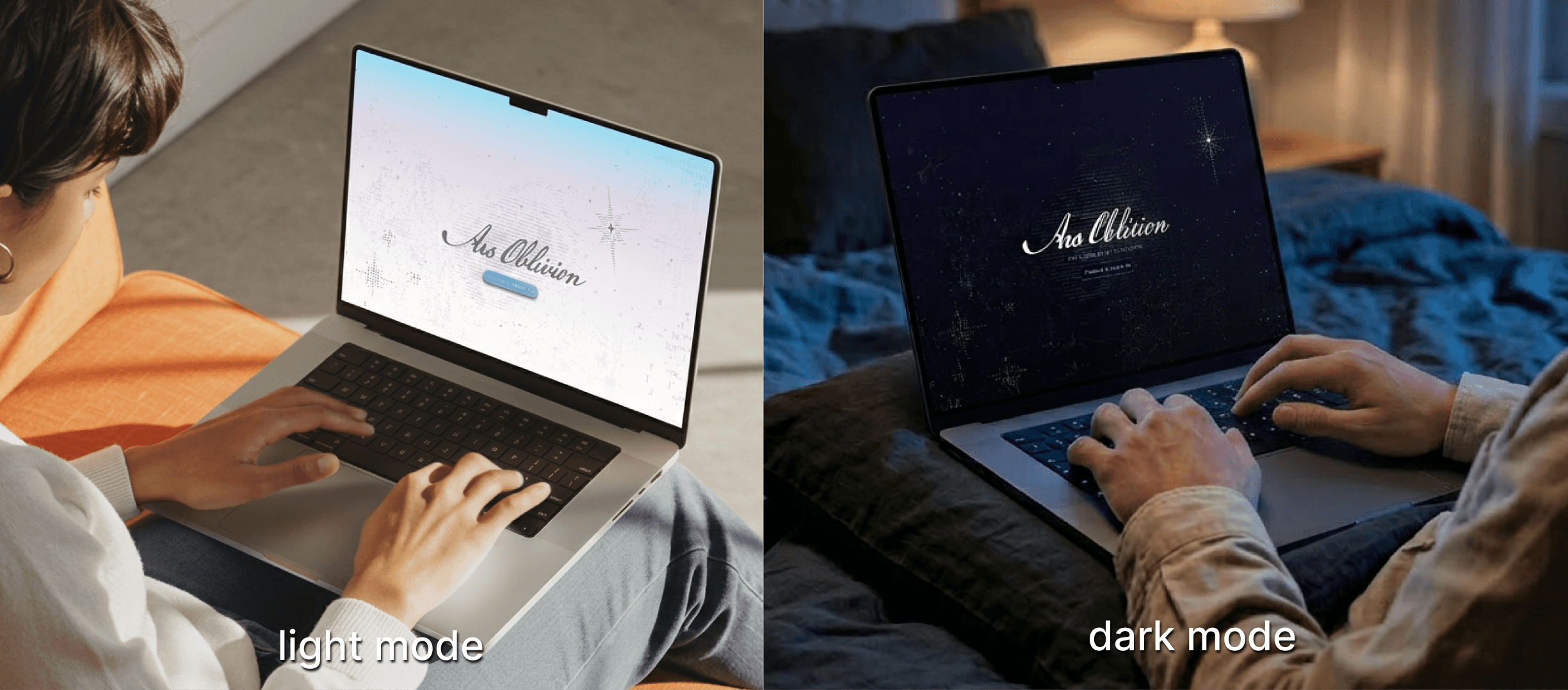
The palette was inspired by the universe — vast, indifferent, and swallowing. Deep navy, night sky, and frost blue were chosen not just for visual calm, but to evoke the specific sadness of letting something go. The universe doesn't hold onto things. Neither should you. The blues also carry nostalgia, that quiet ache that lives alongside regret, making the emotional tone feel honest rather than sterile.
Color & Theme
College students and young adults (19–23) who are emotionally reflective and navigating identity, academic pressure, and relationships. They journal, walk, or distract themselves to process emotions — and while familiar with anonymous digital spaces, they're cautious about privacy and trust aesthetics as a signal of safety.
Who We Designed For
DESIGN DECISION
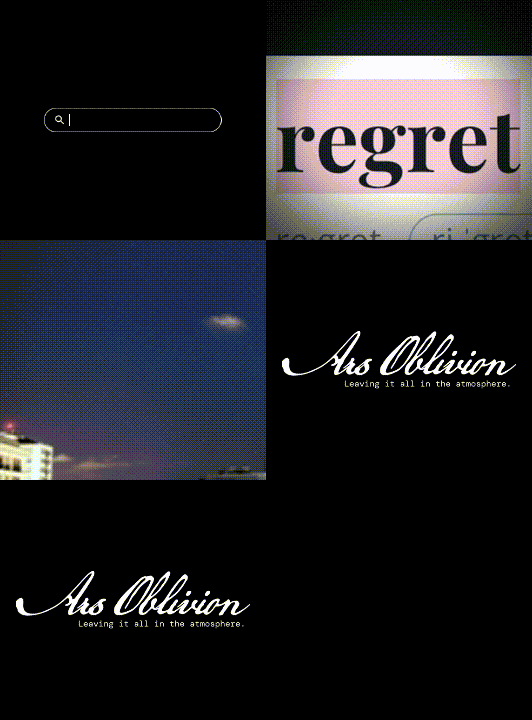
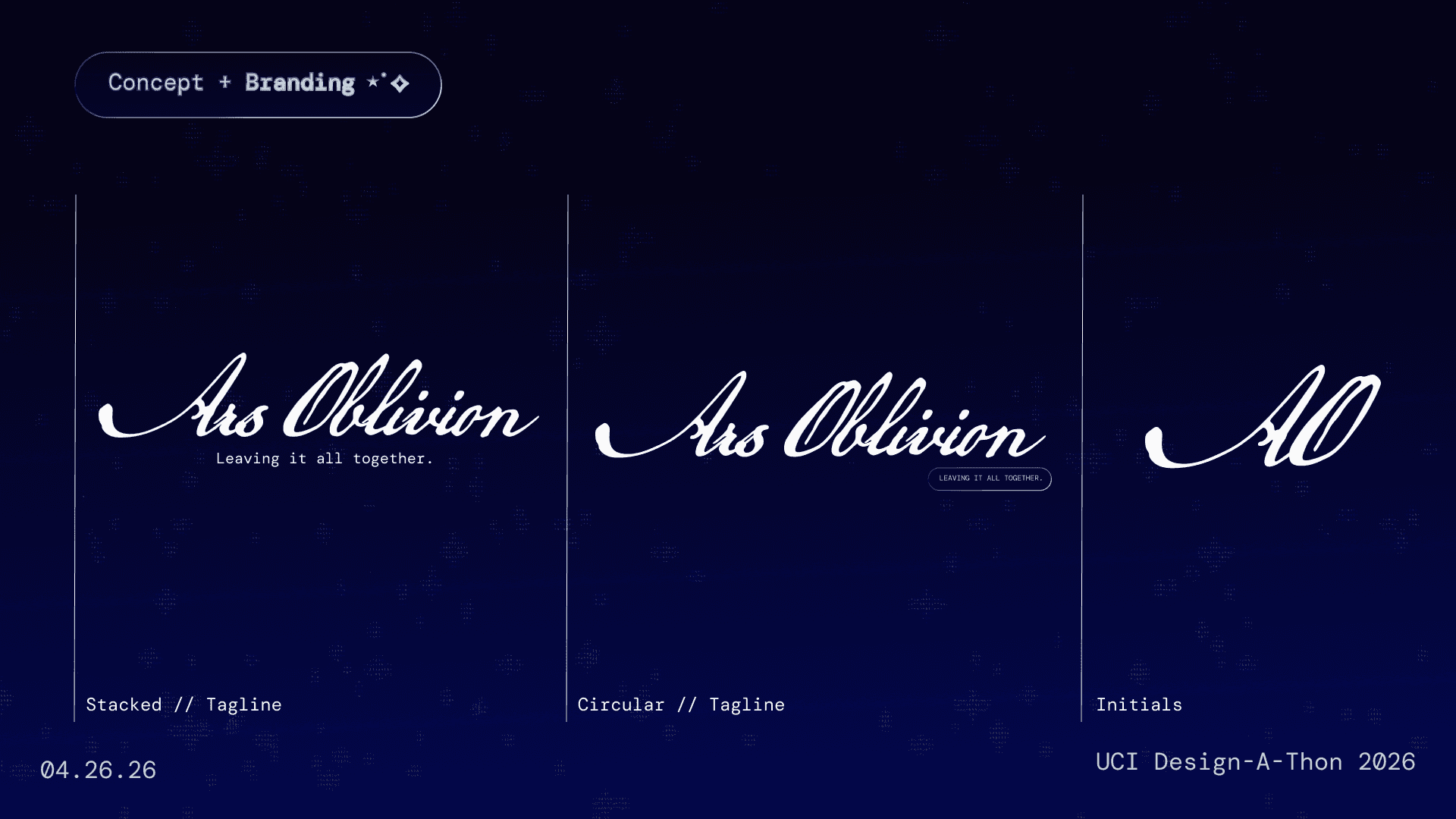
We paired a handwritten script logo with monospaced, pixelated type to merge two worlds: the personal and the digital. The handwritten feel calls back to the ritual of writing something by hand — something meant only for you — while the coded, ASCII-influenced type grounds it in the digital interface it lives on.
Typography
Ars Oblivion's visual identity was built around a central tension — the intimacy of writing a letter and the finality of burning it, translated into a digital space.
Creative Strategy
Inspired by Irvine brands Menya Hanabi and Auntea Jenny, the professional track challenges participants to design products, identities, or experiences that are culturally rooted and community-driven. Like a great meal or neighborhood spot, the mission is to create brands that forge genuine connection and become part of people's everyday lives.
Lost & Found
PROMPT
Regret is something young adults often carry as an isolating, internal burden, this is felt deeply but rarely spoken about.
Modern Day Healing Is Broken
PROBLEM
To give young adults a private, judgment-free space to release regret — and be able to move forward.
GOAL
1
3
2
Anti-archive: Nothing is stored, resurfaced, or revisited.
Emotional Release: The platform transforms regret into a moment of closure, allowing users to move forward with less emotional weight.
No Performance: The space is private and honest, not built for validation or display.
Leaving it all, together.
SOLUTION
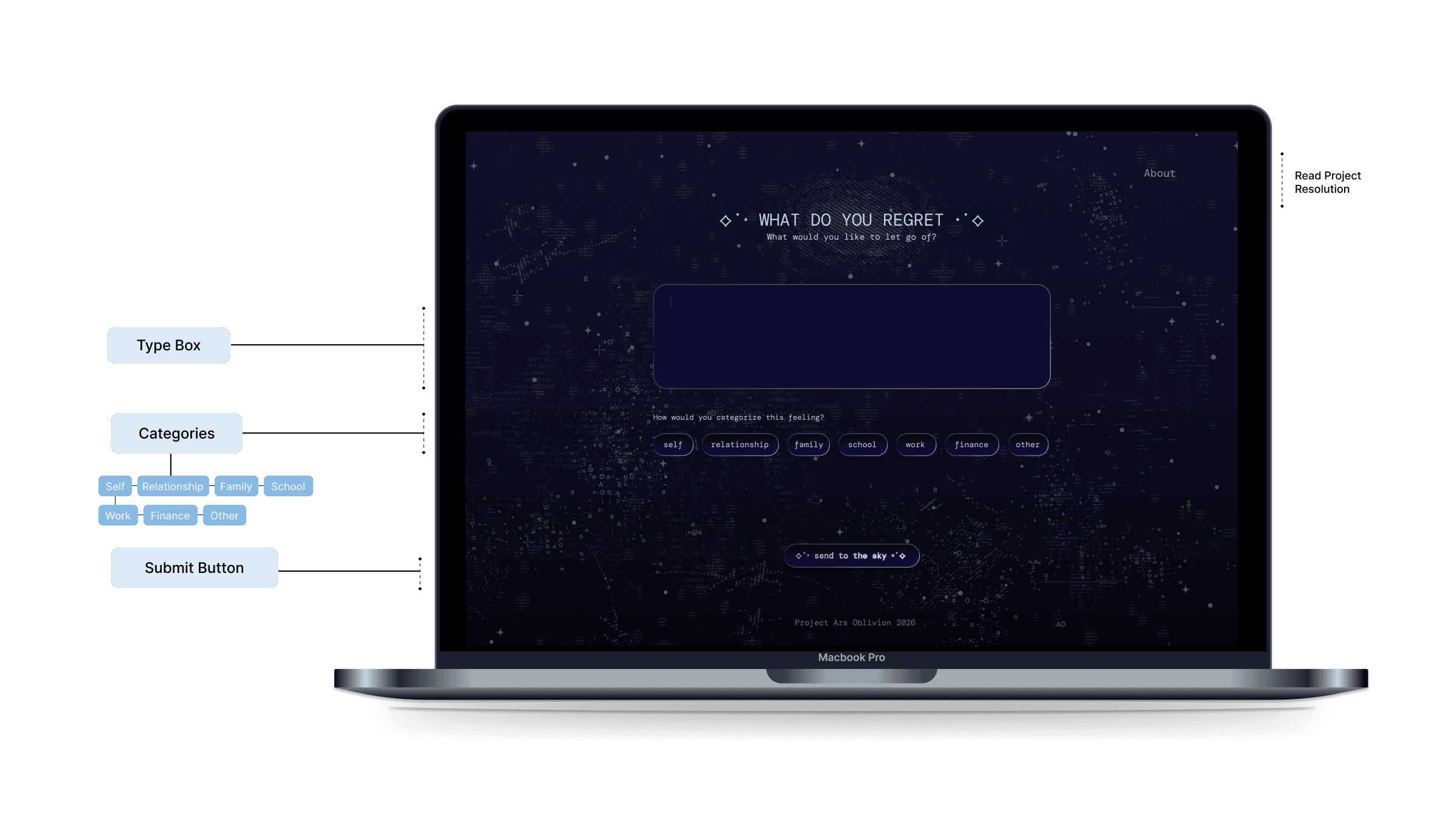
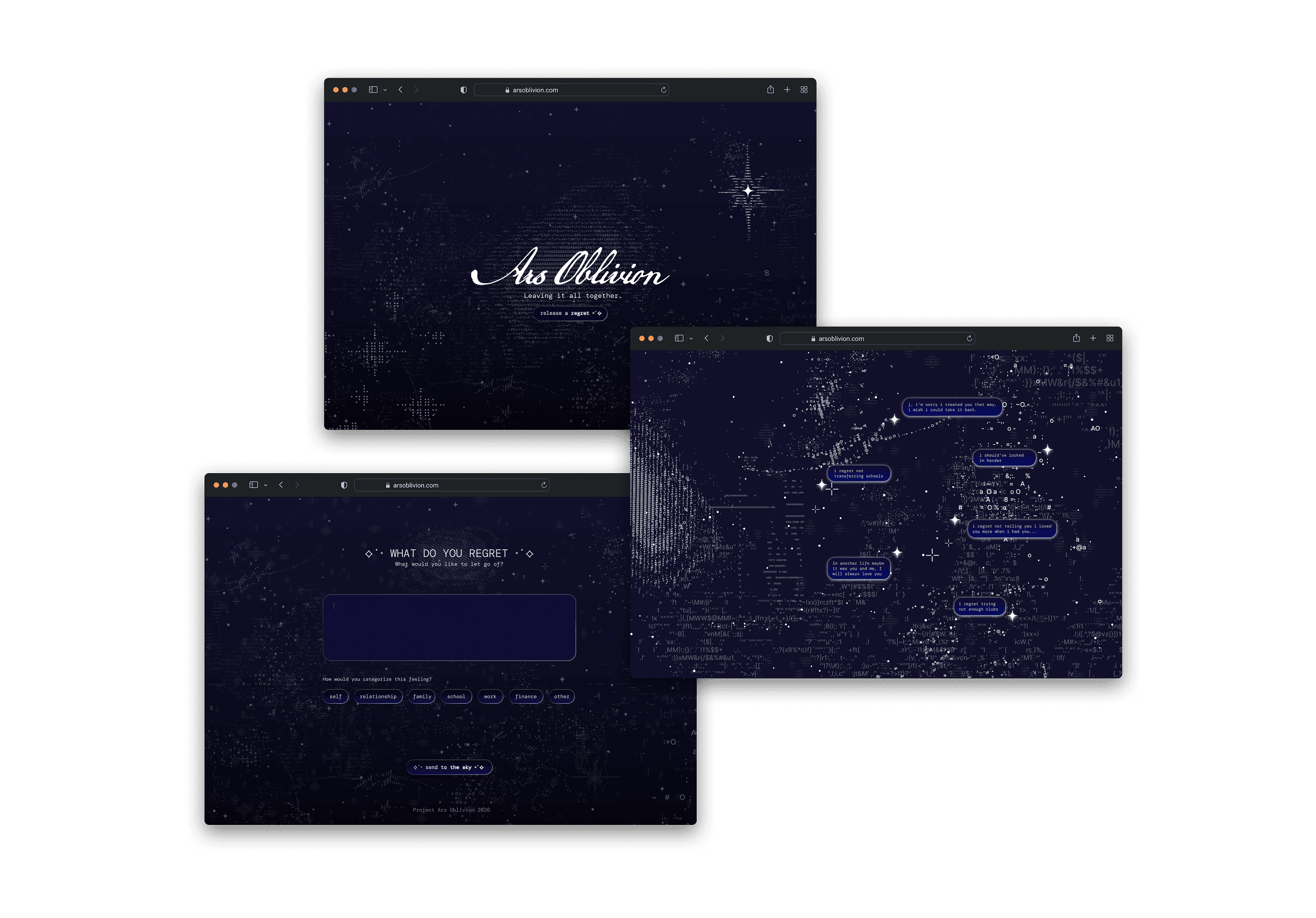
Ars Oblivion is a digital emotional-release platform that helps users process personal regrets through a private, untraceable anti-archive.
The experience is designed to encourage reflection, release, and emotional closure without permanence, performance, or public visibility.
Key Principles:
MY ROLE
Brand Designer
UX Researcher
TEAM
Adrianna D
Mani E
Emma W
CONTEXT
UCI's 2026
Design-A-Thon
TOOLS
Figma
Photoshop
Illustrator
Perplexity
TIMELINE
3 Days
Ars Oblivion In Context
BEYOND THE SCREEN
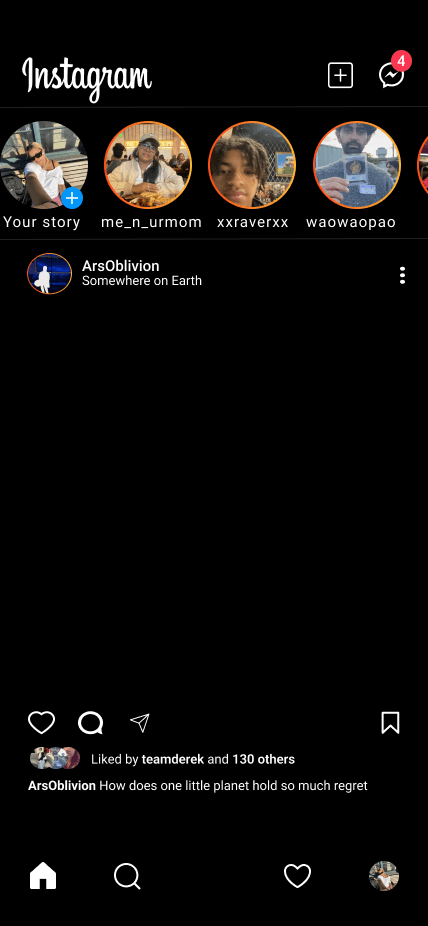
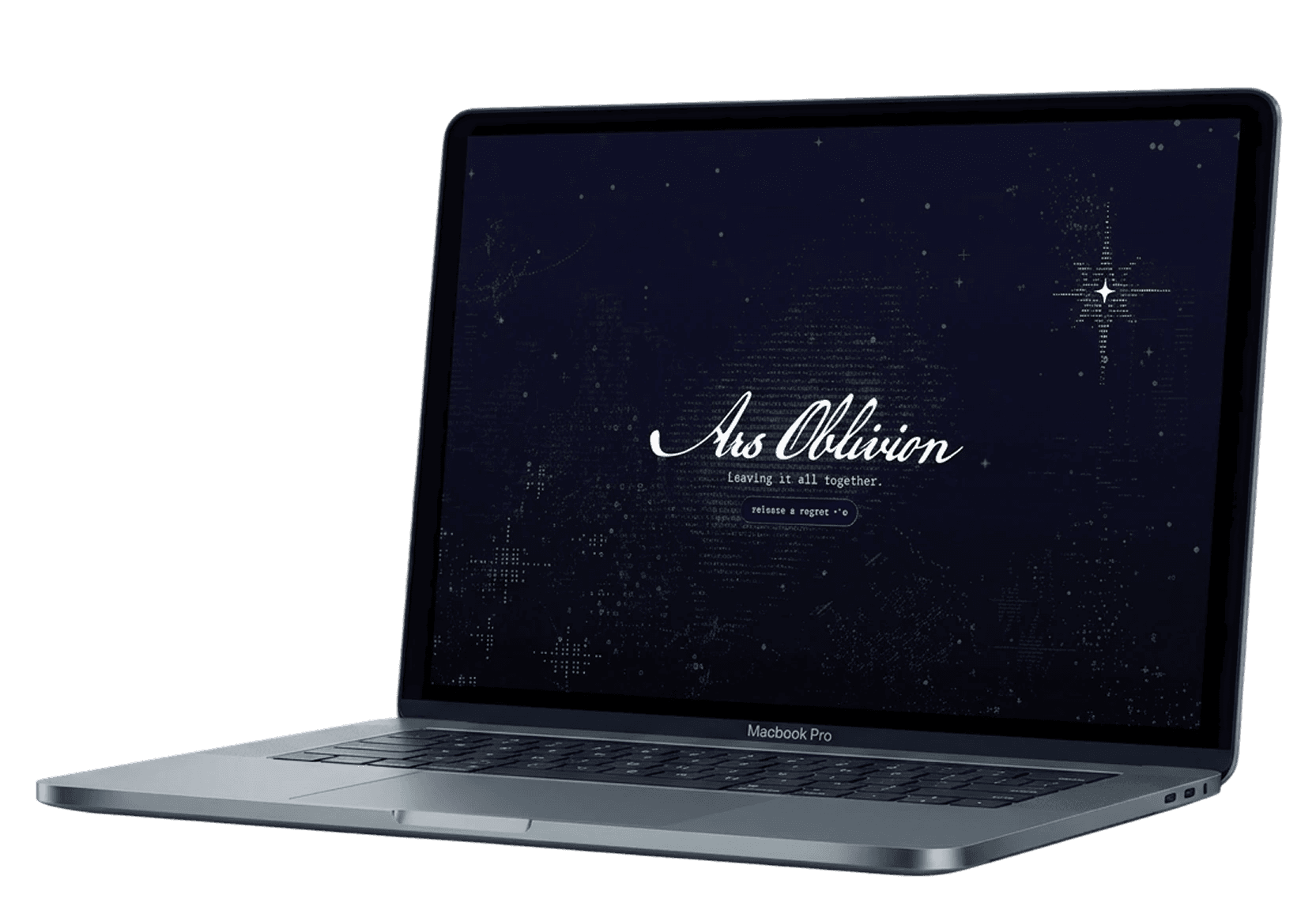
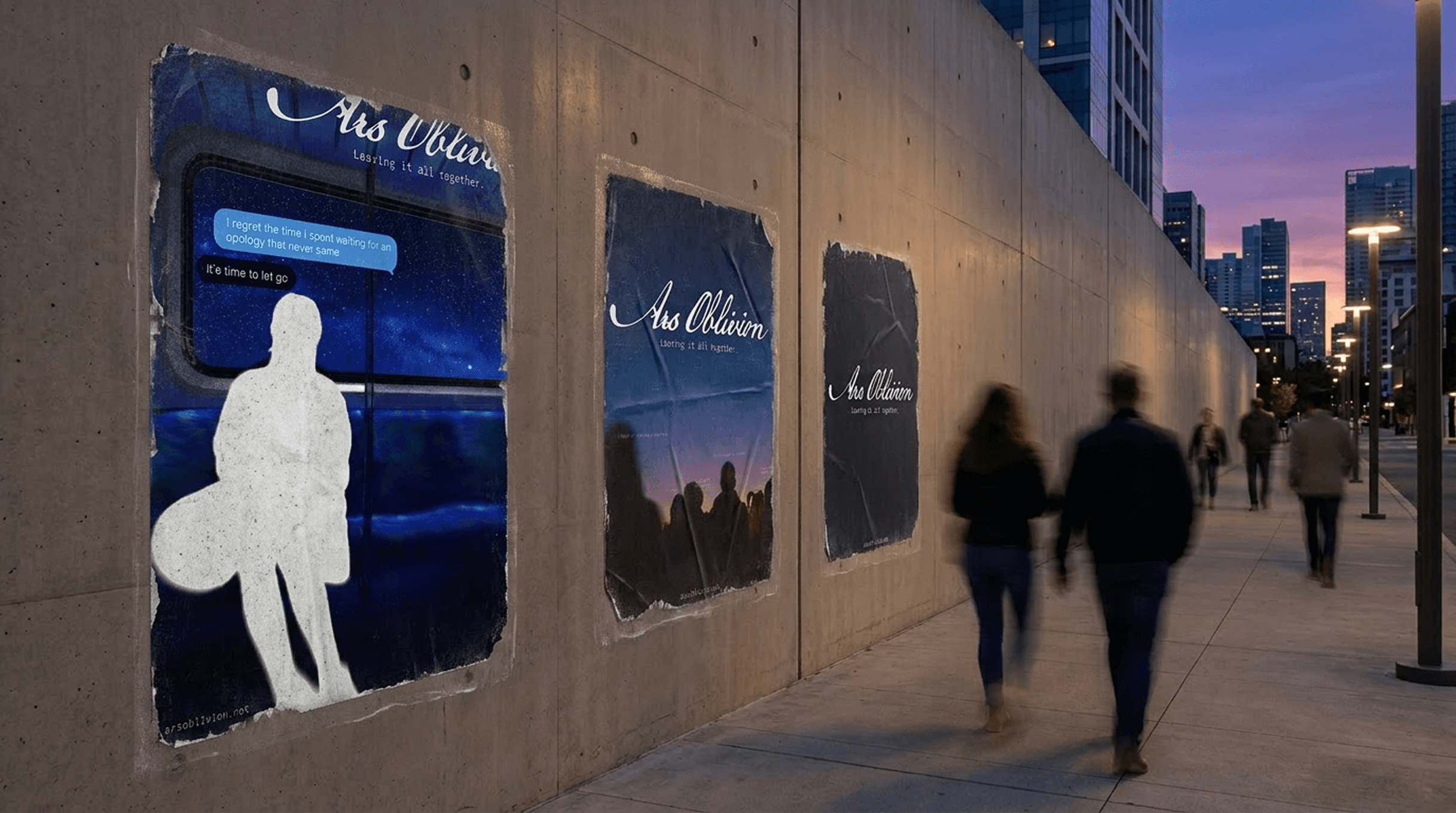
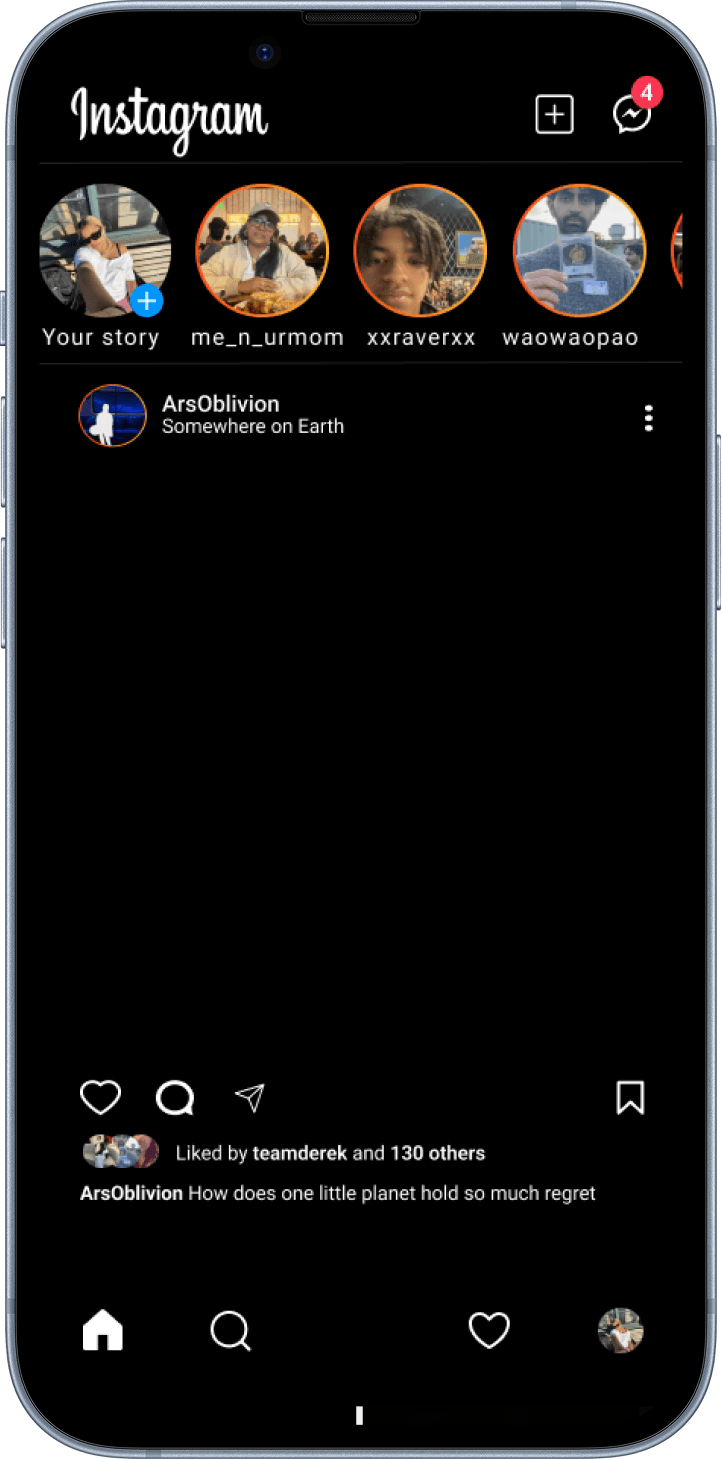
Ars Oblivion was designed to feel like more than an app — a brand with a presence, a community of young adults who choose release over rumination. From posters to social media, the identity extends into everyday spaces, carrying the same quiet message: how does one little planet hold so much regret? Somewhere on Earth, someone else is letting go too.
MY ROLE
Brand Designer
UX Researcher
TEAM
Adrianna D
Mani E
Emma W
CONTEXT
UCI's 2026
Design-A-Thon
TOOLS
Figma
Photoshop
Illustrator
Perplexity
TIMELINE
3 Days
SKILL & GROWTH
Unique Concept To Life: The Art of Letting Go
Ars Oblivion isn't magic. Releasing a regret into the void won't make you forget, and it was never meant to. The intention is quieter than that: to remind you that you are not alone in what you carry. Every regret you release joins countless others, held by people just like you, living their lives on the same earth. It's an invisible contract between you and the universe — a quiet declaration that you are ready to let go. No data saved. No one watching. No interference. Just you, and the choice to release.
This project was challenging, but rewarding in the end. Tackling the idea of forgetting while weaving in a sense of community wasn't easy — regrets are deeply personal, and finding a way to honor that intimacy while still making something that felt collective and uniquely its own was one of the most meaningful design problems we've ever solved.
User Interviews
USER RESEARCH
We conducted qualitative interviews with 7 college students, ages 19–22, to understand how young adults experience and process regret.
2
1
3
Regret is tied to identity
Users linked regret to moments of immaturity, disappointing others, or wishing they had acted differently.
No Performance
The space is private and honest, not built for validation or display.
Emotional Release
The platform transforms regret into a moment of closure, allowing users to move forward with less emotional weight.
We archive our mistakes because they left a mark, while our joys fade because they don't linger. Just like machine learning, we need the failure to map out the flight. You have to stumble once to know exactly where you'll never walk again”
Maliyah Miller, 19
“
The palette was inspired by the universe — vast, indifferent, and swallowing. Deep navy, night sky, and frost blue were chosen not just for visual calm, but to evoke the specific sadness of letting something go. The universe doesn't hold onto things. Neither should you. The blues also carry nostalgia, that quiet ache that lives alongside regret, making the emotional tone feel honest rather than sterile.
Color & Theme
College students and young adults (19–23) who are emotionally reflective and navigating identity, academic pressure, and relationships. They journal, walk, or distract themselves to process emotions — and while familiar with anonymous digital spaces, they're cautious about privacy and trust aesthetics as a signal of safety.
Who We Designed For
DESIGN DECISION
We paired a handwritten script logo with monospaced, pixelated type to merge two worlds: the personal and the digital. The handwritten feel calls back to the ritual of writing something by hand — something meant only for you — while the coded, ASCII-influenced type grounds it in the digital interface it lives on.
Typography
Ars Oblivion's visual identity was built around a central tension — the intimacy of writing a letter and the finality of burning it, translated into a digital space.
Creative Strategy
Inspired by Irvine brands Menya Hanabi and Auntea Jenny, the professional track challenges participants to design products, identities, or experiences that are culturally rooted and community-driven. Like a great meal or neighborhood spot, the mission is to create brands that forge genuine connection and become part of people's everyday lives.
Lost & Found
PROMPT
Regret is something young adults often carry as an isolating, internal burden, this is felt deeply but rarely spoken about.
Modern Day Healing Is Broken
PROBLEM
To give young adults a private, judgment-free space to release regret — and be able to move forward.
GOAL
1
3
2
Anti-archive: Nothing is stored, resurfaced, or revisited.
Emotional Release: The platform transforms regret into a moment of closure, allowing users to move forward with less emotional weight.
No Performance: The space is private and honest, not built for validation or display.
A Digital Tool For Collectors, Built By A Collector
SOLUTION
Ars Oblivion is a digital emotional-release platform that helps users process personal regrets through a private, untraceable anti-archive.
The experience is designed to encourage reflection, release, and emotional closure without permanence, performance, or public visibility.
Key Principles:
SKILL & GROWTH
Unique Concept To Life: The Art of Letting Go
Ars Oblivion isn't magic. Releasing a regret into the void won't make you forget, and it was never meant to. The intention is quieter than that: to remind you that you are not alone in what you carry. Every regret you release joins countless others, held by people just like you, living their lives on the same earth. It's an invisible contract between you and the universe — a quiet declaration that you are ready to let go. No data saved. No one watching. No interference. Just you, and the choice to release.
This project was challenging, but rewarding in the end. Tackling the idea of forgetting while weaving in a sense of community wasn't easy — regrets are deeply personal, and finding a way to honor that intimacy while still making something that felt collective and uniquely its own was one of the most meaningful design problems we've ever solved.
User Interviews
USER RESEARCH
We conducted qualitative interviews with 7 college students, ages 19–22, to understand how young adults experience and process regret.
2
1
3
Regret is tied to identity
Users linked regret to moments of immaturity, disappointing others, or wishing they had acted differently.
No Performance
The space is private and honest, not built for validation or display.
Emotional Release
The platform transforms regret into a moment of closure, allowing users to move forward with less emotional weight.
We archive our mistakes because they left a mark, while our joys fade because they don't linger. Just like machine learning, we need the failure to map out the flight. You have to stumble once to know exactly where you'll never walk again”
Maliyah Miller, 19
“
The palette was inspired by the universe — vast, indifferent, and swallowing. Deep navy, night sky, and frost blue were chosen not just for visual calm, but to evoke the specific sadness of letting something go. The universe doesn't hold onto things. Neither should you. The blues also carry nostalgia, that quiet ache that lives alongside regret, making the emotional tone feel honest rather than sterile.
Color & Theme
College students and young adults (19–23) who are emotionally reflective and navigating identity, academic pressure, and relationships. They journal, walk, or distract themselves to process emotions — and while familiar with anonymous digital spaces, they're cautious about privacy and trust aesthetics as a signal of safety.
Who We Designed For
DESIGN DECISION
We paired a handwritten script logo with monospaced, pixelated type to merge two worlds: the personal and the digital. The handwritten feel calls back to the ritual of writing something by hand — something meant only for you — while the coded, ASCII-influenced type grounds it in the digital interface it lives on.
Typography
Ars Oblivion's visual identity was built around a central tension — the intimacy of writing a letter and the finality of burning it, translated into a digital space.
Creative Strategy
Inspired by Irvine brands Menya Hanabi and Auntea Jenny, the professional track challenges participants to design products, identities, or experiences that are culturally rooted and community-driven. Like a great meal or neighborhood spot, the mission is to create brands that forge genuine connection and become part of people's everyday lives.
Lost & Found
PROMPT
Regret is something young adults often carry as an isolating, internal burden, this is felt deeply but rarely spoken about.
Modern Day Healing Is Broken
PROBLEM
To give young adults a private, judgment-free space to release regret — and be able to move forward.
GOAL
1
3
2
Anti-archive: Nothing is stored, resurfaced, or revisited.
Emotional Release: The platform transforms regret into a moment of closure, allowing users to move forward with less emotional weight.
No Performance: The space is private and honest, not built for validation or display.
A Digital Tool For Collectors, Built By A Collector
SOLUTION
Ars Oblivion is a digital emotional-release platform that helps users process personal regrets through a private, untraceable anti-archive.
The experience is designed to encourage reflection, release, and emotional closure without permanence, performance, or public visibility.
Key Principles:
Inspired by Irvine brands Menya Hanabi and Auntea Jenny, the professional track challenges participants to design products, identities, or experiences that are culturally rooted and community-driven. Like a great meal or neighborhood spot, the mission is to create brands that forge genuine connection and become part of people's everyday lives.
Lost & Found
PROMPT
Regret is something young adults often carry as an isolating, internal burden, this is felt deeply but rarely spoken about.
Modern Day Healing Is Broken
PROBLEM
To give young adults a private, judgment-free space to release regret — and be able to move forward.
GOAL
1
3
2
Anti-archive: Nothing is stored, resurfaced, or revisited.
Emotional Release: The platform transforms regret into a moment of closure, allowing users to move forward with less emotional weight.
No Performance: The space is private and honest, not built for validation or display.
A Digital Tool For Collectors, Built By A Collector
SOLUTION
Ars Oblivion is a digital emotional-release platform that helps users process personal regrets through a private, untraceable anti-archive.
The experience is designed to encourage reflection, release, and emotional closure without permanence, performance, or public visibility.
Key Principles:
User Interviews
USER RESEARCH
We conducted qualitative interviews with 7 college students, ages 19–22, to understand how young adults experience and process regret.
2
1
3
Regret is tied to identity
Users linked regret to moments of immaturity, disappointing others, or wishing they had acted differently.
No Performance
The space is private and honest, not built for validation or display.
Emotional Release
The platform transforms regret into a moment of closure, allowing users to move forward with less emotional weight.
We archive our mistakes because they left a mark, while our joys fade because they don't linger. Just like machine learning, we need the failure to map out the flight. You have to stumble once to know exactly where you'll never walk again”
Maliyah Miller, 19
“
The palette was inspired by the universe — vast, indifferent, and swallowing. Deep navy, night sky, and frost blue were chosen not just for visual calm, but to evoke the specific sadness of letting something go. The universe doesn't hold onto things. Neither should you. The blues also carry nostalgia, that quiet ache that lives alongside regret, making the emotional tone feel honest rather than sterile.
Color & Theme
College students and young adults (19–23) who are emotionally reflective and navigating identity, academic pressure, and relationships. They journal, walk, or distract themselves to process emotions — and while familiar with anonymous digital spaces, they're cautious about privacy and trust aesthetics as a signal of safety.
Who We Designed For
DESIGN DECISION
We paired a handwritten script logo with monospaced, pixelated type to merge two worlds: the personal and the digital. The handwritten feel calls back to the ritual of writing something by hand — something meant only for you — while the coded, ASCII-influenced type grounds it in the digital interface it lives on.
Typography
Ars Oblivion's visual identity was built around a central tension — the intimacy of writing a letter and the finality of burning it, translated into a digital space.
SKILL & GROWTH
Unique Concept To Life: The Art of Letting Go
Ars Oblivion isn't magic. Releasing a regret into the void won't make you forget, and it was never meant to. The intention is quieter than that: to remind you that you are not alone in what you carry. Every regret you release joins countless others, held by people just like you, living their lives on the same earth. It's an invisible contract between you and the universe — a quiet declaration that you are ready to let go. No data saved. No one watching. No interference. Just you, and the choice to release.
This project was challenging, but rewarding in the end. Tackling the idea of forgetting while weaving in a sense of community wasn't easy — regrets are deeply personal, and finding a way to honor that intimacy while still making something that felt collective and uniquely its own was one of the most meaningful design problems we've ever solved.
SKILL & GROWTH
Unique Concept To Life: The Art of Letting Go
Ars Oblivion isn't magic. Releasing a regret into the void won't make you forget, and it was never meant to. The intention is quieter than that: to remind you that you are not alone in what you carry. Every regret you release joins countless others, held by people just like you, living their lives on the same earth. It's an invisible contract between you and the universe — a quiet declaration that you are ready to let go. No data saved. No one watching. No interference. Just you, and the choice to release.
This project was challenging, but rewarding in the end. Tackling the idea of forgetting while weaving in a sense of community wasn't easy — regrets are deeply personal, and finding a way to honor that intimacy while still making something that felt collective and uniquely its own was one of the most meaningful design problems we've ever solved.
User Interviews
USER RESEARCH
We conducted qualitative interviews with 7 college students, ages 19–22, to understand how young adults experience and process regret.
2
1
3
Regret is tied to identity
Users linked regret to moments of immaturity, disappointing others, or wishing they had acted differently.
No Performance
The space is private and honest, not built for validation or display.
Emotional Release
The platform transforms regret into a moment of closure, allowing users to move forward with less emotional weight.
We archive our mistakes because they left a mark, while our joys fade because they don't linger. Just like machine learning, we need the failure to map out the flight. You have to stumble once to know exactly where you'll never walk again”
Maliyah Miller, 19
“
Ars Oblivion In Context
BEYOND THE SCREEN
Ars Oblivion was designed to feel like more than an app — a brand with a presence, a community of young adults who choose release over rumination. From posters to social media, the identity extends into everyday spaces, carrying the same quiet message: how does one little planet hold so much regret? Somewhere on Earth, someone else is letting go too.
Ars Oblivion In Context
BEYOND THE SCREEN
Ars Oblivion was designed to feel like more than an app — a brand with a presence, a community of young adults who choose release over rumination. From posters to social media, the identity extends into everyday spaces, carrying the same quiet message: how does one little planet hold so much regret? Somewhere on Earth, someone else is letting go too.
The palette was inspired by the universe — vast, indifferent, and swallowing. Deep navy, night sky, and frost blue were chosen not just for visual calm, but to evoke the specific sadness of letting something go. The universe doesn't hold onto things. Neither should you. The blues also carry nostalgia, that quiet ache that lives alongside regret, making the emotional tone feel honest rather than sterile.
Color & Theme
College students and young adults (19–23) who are emotionally reflective and navigating identity, academic pressure, and relationships. They journal, walk, or distract themselves to process emotions — and while familiar with anonymous digital spaces, they're cautious about privacy and trust aesthetics as a signal of safety.
Who We Designed For
DESIGN DECISION
We paired a handwritten script logo with monospaced, pixelated type to merge two worlds: the personal and the digital. The handwritten feel calls back to the ritual of writing something by hand — something meant only for you — while the coded, ASCII-influenced type grounds it in the digital interface it lives on.
Typography
Ars Oblivion's visual identity was built around a central tension — the intimacy of writing a letter and the finality of burning it, translated into a digital space.
Creative Strategy
Ars Oblivion In Context
BEYOND THE SCREEN
Ars Oblivion was designed to feel like more than an app — a brand with a presence, a community of young adults who choose release over rumination. From posters to social media, the identity extends into everyday spaces, carrying the same quiet message: how does one little planet hold so much regret? Somewhere on Earth, someone else is letting go too.
Ars Oblivion In Context
BEYOND THE SCREEN
Ars Oblivion was designed to feel like more than an app — a brand with a presence, a community of young adults who choose release over rumination. From posters to social media, the identity extends into everyday spaces, carrying the same quiet message: how does one little planet hold so much regret? Somewhere on Earth, someone else is letting go too.
Ars Oblivion is a digital-first emotional release platform where young adults anonymously surrender their regrets into an untraceable void, transforming the deeply personal act of forgetting into a quiet, collective experience.
ARS
OBLIVION
UCI 2026 Desing-A-Thon: Top 5 Professional Track
5 minute read
5 minute read
Inspired by Irvine brands Menya Hanabi and Auntea Jenny, the professional track challenges participants to design products, identities, or experiences that are culturally rooted and community-driven. Like a great meal or neighborhood spot, the mission is to create brands that forge genuine connection and become part of people's everyday lives.
Lost & Found
PROMPT
Regret is something young adults often carry as an isolating, internal burden, this is felt deeply but rarely spoken about.
Modern Day Healing Is Broken
PROBLEM
To give young adults a private, judgment-free space to release regret — and be able to move forward.
GOAL
1
3
2
Anti-archive: Nothing is stored, resurfaced, or revisited.
Emotional Release: The platform transforms regret into a moment of closure, allowing users to move forward with less emotional weight.
No Performance: The space is private and honest, not built for validation or display.
A Digital Tool For Collectors, Built By A Collector
SOLUTION
Ars Oblivion is a digital emotional-release platform that helps users process personal regrets through a private, untraceable anti-archive.
The experience is designed to encourage reflection, release, and emotional closure without permanence, performance, or public visibility.
Key Principles:
SKILL & GROWTH
Unique Concept To Life: The Art of Letting Go
Ars Oblivion isn't magic. Releasing a regret into the void won't make you forget, and it was never meant to. The intention is quieter than that: to remind you that you are not alone in what you carry. Every regret you release joins countless others, held by people just like you, living their lives on the same earth. It's an invisible contract between you and the universe — a quiet declaration that you are ready to let go. No data saved. No one watching. No interference. Just you, and the choice to release.
This project was challenging, but rewarding in the end. Tackling the idea of forgetting while weaving in a sense of community wasn't easy — regrets are deeply personal, and finding a way to honor that intimacy while still making something that felt collective and uniquely its own was one of the most meaningful design problems we've ever solved.
User Interviews
USER RESEARCH
We conducted qualitative interviews with 7 college students, ages 19–22, to understand how young adults experience and process regret.
2
1
3
Regret is tied to identity
Users linked regret to moments of immaturity, disappointing others, or wishing they had acted differently.
No Performance
The space is private and honest, not built for validation or display.
Emotional Release
The platform transforms regret into a moment of closure, allowing users to move forward with less emotional weight.
We archive our mistakes because they left a mark, while our joys fade because they don't linger. Just like machine learning, we need the failure to map out the flight. You have to stumble once to know exactly where you'll never walk again”
Maliyah Miller, 19
“
The palette was inspired by the universe — vast, indifferent, and swallowing. Deep navy, night sky, and frost blue were chosen not just for visual calm, but to evoke the specific sadness of letting something go. The universe doesn't hold onto things. Neither should you. The blues also carry nostalgia, that quiet ache that lives alongside regret, making the emotional tone feel honest rather than sterile.
Color & Theme
College students and young adults (19–23) who are emotionally reflective and navigating identity, academic pressure, and relationships. They journal, walk, or distract themselves to process emotions — and while familiar with anonymous digital spaces, they're cautious about privacy and trust aesthetics as a signal of safety.
Who We Designed For
DESIGN DECISION
We paired a handwritten script logo with monospaced, pixelated type to merge two worlds: the personal and the digital. The handwritten feel calls back to the ritual of writing something by hand — something meant only for you — while the coded, ASCII-influenced type grounds it in the digital interface it lives on.
Typography
Ars Oblivion's visual identity was built around a central tension — the intimacy of writing a letter and the finality of burning it, translated into a digital space.
Creative Strategy
Ars Oblivion In Context
BEYOND THE SCREEN
Ars Oblivion was designed to feel like more than an app — a brand with a presence, a community of young adults who choose release over rumination. From posters to social media, the identity extends into everyday spaces, carrying the same quiet message: how does one little planet hold so much regret? Somewhere on Earth, someone else is letting go too.
Ars Oblivion is a digital-first emotional release platform where young adults anonymously surrender their regrets into an untraceable void, transforming the deeply personal act of forgetting into a quiet, collective experience.
UCI 2026 Desing-A-Thon: Top 5 Professional Track
ARS OBLIVION
5 minute read
MY ROLE
Brand Designer
UX/UI Designer
TEAM
Adrianna D
Mani E
Emma W
CONTEXT
UCI's 2026 Design-A-Thon
TOOLS
Figma
Photoshop
Illustrator
Perplexity
TIMELINE
3 Days